Here's something most hiring managers don't talk about: you can find the perfect candidate, complete a flawless interview process, and still watch that new hire underperform for months. The problem isn't the hiring decision. It's what happens in those critical first weeks when a one-size-fits-all orientation fails to address what that specific person actually needs to succeed.
Generic onboarding treats every new employee like they have identical skill gaps, identical learning styles, and identical development priorities. Spoiler: they don't. When a candidate shows exceptional strategic thinking but struggles with prioritization, your standard onboarding program won't catch that. When someone has deep technical skills but needs stronger communication frameworks, your three-day orientation won't solve it.
This is why 68% of organizations struggle to personalize onboarding at scale, even though companies using customized approaches see a 19% productivity increase in the first 90 days. The gap between generic training and personalized development isn't just about employee satisfaction it directly impacts time-to-productivity, retention rates, and long-term performance ROI.
This guide shows you exactly how to build personalized onboarding plans that identify individual development needs during assessment, structure training around those specific gaps, and create measurable performance improvements from day one.
Key Takeaways
– Conduct individual development needs assessments before onboarding starts to identify specific capability gaps that generic training won't address
– Structure the first 30-60 days around 2-3 high-impact development priorities unique to each hire rather than forcing everyone through identical orientation
– Use cognitive assessments and job simulation interviews during hiring to predict which skills need strengthening before the start date
– Create role-specific onboarding tracks that customize training intensity based on where each person currently sits on the capability spectrum
– Implement biweekly 1:1 coaching check-ins to adjust development plans based on real-time progress and emerging skill needs
– Measure onboarding success through time-to-productivity metrics and performance improvements, not just training completion rates
Why Generic Onboarding Fails (And What That Costs You)
Most onboarding programs operate on a dangerous assumption: every new hire needs the same information delivered the same way in the same sequence. Companies invest thousands building comprehensive orientation decks, standard operating procedure manuals, and multi-week training calendars then wonder why some employees take twice as long to reach full productivity.
The truth? Only 29% of companies provide structured 90-day onboarding programs, and even fewer customize those programs to individual development needs. The rest default to generic training that wastes time teaching skills people already have while completely missing the capabilities they actually need to build.
Think about what this looks like in practice. Your new marketing coordinator might be brilliant at content strategy but need significant development in project management structure. Your generic onboarding spends three days on "content fundamentals" she already mastered five years ago, then gives her a 45-minute overview of your project workflow before throwing her into campaign execution. Three months later, you're frustrated that deadlines keep slipping and she's overwhelmed trying to figure out systems nobody properly taught her.
Here's what generic onboarding typically costs:
Time-to-productivity delays: Employees without personalized development plans take 34% longer to reach full productivity compared to those with structured, customized onboarding.
Early turnover increases: Companies with standard (not personalized) onboarding experience 50% lower new hire retention rates in the first year.
Hidden opportunity costs: When capable people spend weeks in training that doesn't address their actual development needs, you're paying full salary for partial productivity while competitors move faster.
The organizations getting this right approach onboarding as an individual development strategy, not a standardized orientation checklist.
Understanding Individual Development Needs Assessment
Before you can build a personalized onboarding plan, you need to know what you're personalizing for. This requires shifting from "What does this role require?" to "What does this specific person need to develop to excel in this role?"
The Three-Layer Assessment Framework
Effective individual development needs assessment happens in three distinct layers, and the best recruitment models start this process during hiring, not after.
Layer 1: Cognitive Ability Assessment
Research in personnel selection spanning 85 years consistently shows that cognitive ability is the single strongest predictor of job performance, with a validity coefficient of .51. Translation: cognitive assessments predict job success more accurately than resumes, years of experience, or unstructured interviews.
But here's what matters for onboarding. Cognitive assessments don't just tell you if someone can do the job. They reveal how that person processes information, solves problems, and learns new systems. Someone with high analytical reasoning but lower numerical processing might excel at strategic planning but need additional support with budget management or data analysis tasks.
When you understand these cognitive patterns before day one, you can structure onboarding to leverage strengths while deliberately building capabilities in development areas.
Layer 2: Job Simulation Performance Analysis
Job simulations during the hiring process serve double duty. They predict performance accuracy (work sample tests have a .54 validity coefficient), and they reveal exactly where capability gaps exist.
Let's say you're hiring a virtual assistant for property management coordination. Instead of asking hypothetical questions, you give candidates a realistic scenario: "You have three maintenance emergencies, two tenant complaints, and a vendor who missed their appointment. You have 15 minutes. Show me how you prioritize and respond."
The candidates who succeed reveal their current capability level. The ones who struggle show you precisely what skills need development whether that's prioritization frameworks, communication tone, systems thinking, or stress management. That insight becomes the foundation of their personalized onboarding plan.
Layer 3: Emotional Intelligence Evaluation
Technical skills get people hired. Emotional intelligence determines whether they thrive. Emotional intelligence assessments during hiring reveal how candidates handle feedback, navigate interpersonal dynamics, manage stress, and adapt to change.
For onboarding purposes, this matters enormously. Someone with strong self-awareness but developing empathy skills needs different relationship-building support than someone who reads others well but struggles with self-regulation under pressure. Your personalized onboarding plan should account for these EQ development areas alongside technical skill-building.
Translating Assessment Data Into Development Priorities
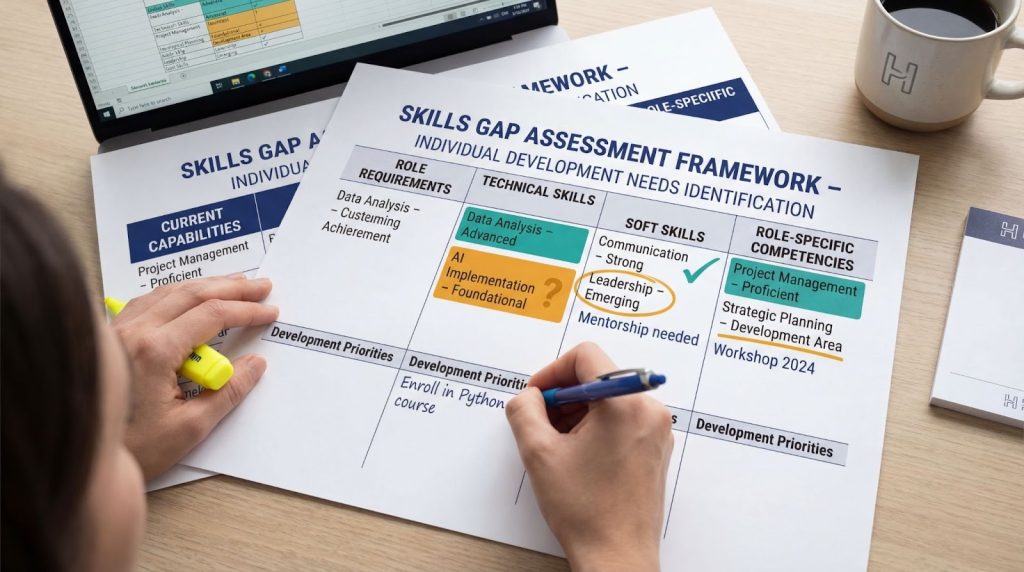
Once you've gathered assessment data across these three layers, the next step is synthesis. You're looking for 2-3 high-impact development priorities that will create the biggest performance leverage for this specific person in this specific role.
Ask yourself:
– Where do capability gaps create the highest friction for role success?
– Which skills can this person develop quickly with structured support?
– What strengths can we leverage immediately while building developing areas?
A operations coordinator might show exceptional problem-solving ability and strong emotional intelligence but reveal through job simulation that their organizational systems need significant structure. Your personalized onboarding plan focuses heavily on workflow frameworks, prioritization methodologies, and project management tools while giving lighter touch to relationship-building skills they already possess.
That's personalization that actually drives results.
Building Your Personalized Onboarding Framework
You've identified individual development needs. Now you need a framework that translates those insights into an actual onboarding plan that people can follow and that managers can execute consistently.
Step 1: Create Role-Specific Onboarding Tracks
Start by building 3-4 foundational onboarding tracks based on role families, not individual positions. Your "Operations Support" track might serve executive assistants, coordinators, and project managers. Your "Client-Facing" track could cover sales development, account management, and customer success roles.
Each track includes core competencies everyone in that role family needs: tools, workflows, communication protocols, cultural expectations. This creates your baseline the 60-70% of onboarding content that stays consistent.
Here's what most companies miss: that remaining 30-40% should flex dramatically based on individual development needs identified during assessment.
Step 2: Map Development Needs to Onboarding Modules
Take those 2-3 high-impact development priorities for each new hire and build (or select from your library) focused onboarding modules that directly address those gaps.
If someone needs stronger prioritization skills, their personalized onboarding plan includes:
– A dedicated 90-minute workshop on prioritization frameworks (Eisenhower Matrix, MoSCoW method, value vs. effort mapping)
– Three coached practice scenarios with real work examples
– Weekly prioritization reviews for the first 30 days
– A workload calibration check-in at day 45
If someone else in the same role already has excellent prioritization but needs communication structure development, they skip that module entirely and instead get:
– Training on your communication protocols and escalation frameworks
– Templates for common communication scenarios
– Feedback loops on email tone, meeting facilitation, and stakeholder updates
– Paired mentorship with a team member who excels at communication
Same role. Completely different onboarding experience. That's personalization that respects people's time and accelerates their development.
Step 3: Sequence Learning Based on Cognitive Load
One of the biggest onboarding mistakes is information overload during the first week. New hires meet 47 people, learn six software platforms, memorize organizational charts, and try to absorb company history, values, and 127 SOPs while also trying to make a good first impression.
Personalized onboarding accounts for cognitive load by sequencing learning strategically.
Days 1-5: Foundations + One Primary Development Focus
Cover only the absolute essentials: systems access, core team introductions, immediate workflow needs. Then introduce one and only one of their development priorities with hands-on practice.
Days 6-30: Progressive Complexity + Second Development Focus
Expand responsibilities gradually while introducing the second development priority. By now, they have enough context to connect new learning to actual work application.
Days 31-60: Full Integration + Third Development Focus (If Applicable)
At this point, they're contributing meaningfully to real work. The third development priority (if they have one) gets introduced while the first two are reinforced through coached application.
This sequencing prevents overwhelm while ensuring development needs get addressed systematically.
Step 4: Build in Bi-Weekly Coaching Checkpoints
Here's where most personalized onboarding plans fall apart: they get created, then abandoned.
Effective implementation requires structured coaching checkpoints every two weeks during the first 90 days. These aren't casual check-ins. They're focused development conversations built around three questions:
1 Which of your development priorities are you making measurable progress on?
2 Where are you still struggling, and what specific support would help?
3 What's emerging as a new development need we didn't initially identify?
These check-ins serve two purposes. They create accountability for both the new hire and the organization to actually follow the personalized plan. And they allow real-time adjustment when initial development priorities shift or new gaps emerge.
Documentation matters here. Track what's working, what isn't, and how development priorities evolve. That data becomes intelligence for improving future onboarding personalization.
Customized Training Delivery for Different Learning Needs
Even the best personalized onboarding plan fails if your training delivery doesn't match how people actually learn. This is where understanding individual development needs extends beyond what skills to build into how to build them.
Matching Training Methods to Development Goals
Different development priorities require different training approaches. Technical skill-building (learning your CRM, mastering your project management platform, understanding your service delivery workflow) responds well to structured tutorials, recorded walkthroughs, and hands-on practice with immediate feedback.
Soft skill development (communication frameworks, prioritization methods, emotional intelligence application) needs coaching, real-time feedback, and deliberate practice in authentic work scenarios. You can't learn prioritization from a slideshow. You learn it by making prioritization decisions, getting coached feedback, and refining your approach.
Strategic capability building (systems thinking, business context, cross-functional understanding) requires exposure to why decisions get made, not just how tasks get completed. This means involving new hires in meetings above their immediate responsibility level, explaining strategic context for workflows, and connecting their role to business outcomes.
Your personalized onboarding plan should specify not just what each person needs to develop but how that development will happen.
Creating Practice-Based Learning Opportunities
The highest-impact personalized onboarding programs build development through progressively complex real work, not simulated scenarios.
Here's how that works in practice. Your new executive assistant needs to develop meeting facilitation skills. Instead of classroom training, their personalized onboarding plan includes:
– Week 1: Observe three meetings led by experienced team members, with post-meeting debrief on facilitation techniques
– Week 2: Co-facilitate one low-stakes internal team sync with coaching support
– Week 3: Lead one client-facing meeting with experienced colleague present for backup and feedback
– Week 4: Full ownership of weekly team meeting with recorded self-review and coaching feedback
Each step builds the skill through authentic application while managing risk through graduated responsibility.
Adjusting Pace Based on Development Progress
Not everyone develops capabilities at the same speed. Personalized onboarding plans should include pace flexibility based on how quickly someone is mastering their development priorities.
If someone accelerates through their prioritization skill-building in two weeks instead of the planned four, shift them to the next development focus early. Don't make them sit through two extra weeks of content they've already mastered just because the plan said four weeks.
Conversely, if someone needs extra time and support on a particular development area, give it. Rushing someone through communication framework development because "the plan says we move on this week" defeats the entire purpose of personalization.
Track development progress through observable performance indicators, not just calendar days. Has their prioritization improved measurably? Are they consistently applying the frameworks you taught? Can they handle realistic complexity independently? Those answers determine pace, not arbitrary timelines.
Measuring Personalized Onboarding Effectiveness
You can't improve what you don't measure. Personalized onboarding requires specific metrics that go beyond generic "training completed" checkboxes.
Time-to-Productivity Metrics
The primary success measure for personalized onboarding is simple: how quickly does someone reach full productivity in their role?
Define "full productivity" clearly for each role family. For a sales development representative, it might be "generating 15 qualified leads per week." For a property management coordinator, it could be "independently managing three properties with zero missed critical deadlines."
Then measure how long it takes people with personalized onboarding plans to hit that benchmark compared to historical averages. Organizations that implement customized onboarding approaches report 15% faster time-to-productivity. If your current average is 90 days to full productivity, personalized onboarding should consistently achieve it in 75-80 days.
Track this data by development priority categories. Do people with prioritization development needs reach productivity faster or slower than those working on communication skills? That intelligence helps you refine your assessment process and onboarding module effectiveness.
Development Priority Achievement Rates
For each new hire's 2-3 identified development priorities, create observable performance indicators that demonstrate mastery.
If prioritization was a development focus, your performance indicator might be: "Consistently submits deliverables on deadline with zero late submissions for three consecutive weeks."
If communication structure was the priority: "Stakeholder update emails require minimal revision, meeting notes include clear action items and owners, escalations follow proper protocols."
Measure what percentage of new hires achieve their development priority performance indicators within 60 days. Strong personalized onboarding programs should see 80%+ achievement rates. If you're consistently below that, either your development priorities aren't well-targeted or your training delivery isn't effective.
Retention and Engagement Data
Here's a metric most companies miss: measure whether employees with personalized onboarding plans report higher engagement and stay longer than those who went through generic orientation.
Survey new hires at 30, 60, and 90 days specifically about their onboarding experience. Ask questions like:
– Did your onboarding address the specific skills you needed to develop?
– How well did training match your actual work challenges?
– Did you feel your individual development needs were understood and supported?
Research shows that 97% of employees with customized onboarding report feeling supported within their first 90 days, compared to just 52% with generic orientation. That feeling of support directly correlates to 82% higher retention rates.
Track voluntary turnover rates for employees who received personalized onboarding versus those who didn't. The data will make your business case for investing in continued personalization.
Common Pitfalls and How to Avoid Them
Even organizations committed to personalized onboarding make predictable mistakes. Here's how to avoid the most common ones.
Mistake 1: Assessing Development Needs After Hiring
If you wait until someone's first day to figure out what they need to develop, you've already lost two weeks. The assessment phase should happen during your hiring process, integrated into your interview structure and selection methodology.
Use cognitive assessments, job simulations, and structured interviews to identify development priorities before you extend the offer. That way, their personalized onboarding plan is ready on day one, not improvised during week two.
Mistake 2: Creating Personalization Theater
Some organizations claim personalization while actually just letting new hires "choose their own adventure" from a menu of generic training modules. That's not personalization. That's preference-based selection, and it doesn't work because new hires don't always know what they don't know.
True personalization means expert assessment of development needs combined with strategically sequenced training that addresses those specific gaps. The new hire shouldn't be guessing what they need to learn. Your assessment process should tell you, and your onboarding plan should deliver it.
Mistake 3: Personalizing Content But Not Delivery
You can have perfectly identified development priorities and customized learning modules but still fail if you deliver everything through the same methods to everyone.
Some people need hands-on practice before concepts make sense. Others need conceptual frameworks first, then application. Some need written resources they can reference. Others learn better through conversation and coaching.
Build multiple delivery pathways for key development modules self-paced videos, live workshops, 1:1 coaching, peer learning pods and match people to the delivery methods that fit their learning style.
Mistake 4: Abandoning the Plan After Week 2
The biggest personalized onboarding failure isn't poor planning. It's poor follow-through.
Managers get busy. New hires get caught up in immediate work demands. The carefully crafted personalized development plan sits untouched after the first week while everyone defaults back to "figure it out as you go."
This is why structured bi-weekly coaching check-ins are non-negotiable. Calendar them before day one. Treat them as sacred. Use them to hold both the manager and new hire accountable to actually executing the personalized plan.
Frequently Asked Questions About Personalized Onboarding Plans
How do you identify individual development needs during hiring without adding weeks to your recruitment timeline?
Integrate assessment into your existing hiring process instead of adding extra steps. Replace unstructured "tell me about a time" interviews with job simulation exercises that reveal capability gaps while predicting performance. Use validated cognitive and emotional intelligence assessments that candidates complete in 20-30 minutes. Structure your interview questions to probe for specific skill demonstrations. With this approach, you're gathering development needs intelligence through activities that improve hiring decisions anyway, not through separate assessment phases.
Can small companies without dedicated L&D teams actually implement personalized onboarding at scale?
Absolutely, and often more effectively than large organizations. Start by building 3-4 core onboarding tracks for your main role families. Within each track, create modular development components (prioritization training, communication frameworks, technical skill modules) that can be mixed and matched based on individual needs. You don't need custom content for every person. You need smart frameworks that let you assemble personalized plans quickly from reusable, high-quality components. A manager with a clear development needs assessment can build a personalized 90-day plan in under an hour using this modular approach.
What if someone's development needs change after onboarding starts?
That's exactly why bi-weekly coaching check-ins exist. Development priorities should be treated as hypotheses, not fixed mandates. If you initially identified prioritization as a development need but discover two weeks in that the real issue is unclear role expectations, adjust the plan. The goal isn't rigid adherence to the original assessment. The goal is helping someone build the capabilities they actually need to succeed. Track what you learn from these mid-course corrections. Patterns in shifted priorities indicate where your initial assessment process needs refinement.
How does personalized onboarding work for remote employees who need more structured support?
Remote employees benefit even more from personalized onboarding because they can't learn by osmosis the way office-based employees sometimes do. The key is building personalization around how they'll actually work. If someone's development priority is communication structure, their remote onboarding should include recorded examples of excellent async communication, templates for common scenarios, and feedback loops on their written updates. If they need prioritization development, implement daily 15-minute check-ins for the first two weeks where they talk through their prioritization decisions with coaching support. Remote personalization succeeds when you're deliberate about creating the touch points and practice opportunities that office proximity usually provides accidentally.
What's a realistic timeline for someone to complete a personalized onboarding plan?
It depends entirely on role complexity and how many development priorities someone has. For most professional roles, effective personalized onboarding spans 60-90 days. The first 30 days focus on foundations plus one primary development priority. Days 31-60 introduce the second development area while reinforcing the first through application. Days 61-90 bring full integration, with coaching shifting from intensive instruction to periodic reinforcement. Some roles with minimal complexity might complete personalized onboarding in 45 days. Complex strategic roles might extend to 120 days. The metric that matters isn't calendar time but time-to-full-productivity compared to your historical baseline.
Making Personalized Onboarding Your Competitive Advantage
Companies that treat onboarding as a standardized checklist accept that some percentage of new hires will underperform for months, some will never reach full potential, and some will leave before ROI breaks even. They've decided that's just the cost of hiring.
Organizations that build personalized onboarding plans around individual development needs operate differently. They recognize that the capability gap between "this person got hired" and "this person is crushing it" can be closed systematically. They understand that time-to-productivity isn't a fixed variable. It's a outcome you can engineer through smart assessment, customized development, and structured coaching.
The data proves this works. Companies using personalized onboarding approaches see 19% higher productivity in the first 90 days, 82% better retention rates, and 34% faster time-to-full-productivity. But the competitive advantage goes deeper than statistics.
When you build onboarding around individual development needs, you signal something powerful to every new hire: we see you as a complete professional with specific strengths and deliberate growth areas. We're not trying to force you into a generic mold. We're investing in helping you become the highest-performing version of yourself in this role.
That message creates loyalty, engagement, and performance that standard orientation never will.
Ready to transform how your team onboards talent? Pathfinder Talent Solutionsspecializes in assessment-driven placement paired with customized onboarding that addresses individual development needs from day one. Our science-backed hiring methodology identifies capability gaps before placement, and our coaching infrastructure ensures every hire reaches full productivity faster. Explore how personalized development planning can become your hiring advantage at Pathfinder Talent Solutions.
The difference between an adequate employee and an exceptional one often comes down to whether someone took the time to understand what they specifically needed to develop and then actually helped them build it. Make that your standard, not your exception.