
You spent weeks onboarding your new virtual assistant. You followed the agency's training checklist religiously. And three months later, they're either gone or still asking basic questions you thought training would have covered.
Sound familiar?
Here's the uncomfortable truth: 67% of VA placements fail within six months. That's not just a statistic—it's $12,000 in lost productivity and rehiring costs every single time. And the real damage goes beyond money. It's the missed deadlines, frustrated clients, and you getting pulled back into the exact tasks you hired someone to handle.
After placing 500+ virtual assistants across seven industries over two decades, we've learned something most staffing agencies won't admit: The problem isn't the virtual assistants. It's the cookie-cutter training that treats everyone the same regardless of their actual development needs.
Generic virtual assistant training programs fail because agencies optimize for scale, not results. They design training that's easy to replicate across hundreds of VAs—same checklists, same timelines, same everything. It's efficient for the agency but devastating for performance outcomes.
In this guide, you'll discover exactly why generic training fails, what research-backed alternatives actually work, and how to tell the difference when evaluating your options.
Key Takeaways
– Generic VA training ignores individual cognitive abilities and emotional intelligence, delivering identical content to everyone regardless of their actual development needs
– Research shows structured assessment combined with ongoing coaching predicts performance 3-5x better than resume screening and orientation-only training
– The five fatal flaws: No needs assessment, cookie-cutter curriculum, training ends at day 30, zero performance measurement, and ignoring offshore cultural differences
– Effective training starts with cognitive and emotional intelligence testing to identify specific gaps before designing personalized curriculum
– Customized training with ongoing biweekly coaching delivers 58% better quality scores and 40% lower turnover than generic programs
– Offshore VAs need additional cultural integration training that generic programs completely overlook
The 5 Fatal Flaws of Generic VA Training
Most VA training follows a conveyor belt model. Agencies process high volumes because that's how they maximize revenue. Training becomes a checkbox to complete before moving to the next placement.
The result? VAs who technically "completed training" but can't handle the actual complexity of their role.
Flaw #1 : No Individual Needs Assessment
Generic programs skip the diagnostic phase entirely. Every VA gets identical training whether they're strong strategically but weak on prioritization, or the complete opposite.
Think about it: you wouldn't prescribe the same medication to every patient without diagnosing their condition first. Yet that's exactly what happens with VA training.
Effective training starts with structured assessment—cognitive ability testing (how fast do they learn?), emotional intelligence evaluation (how well do they communicate and handle feedback?), and job simulation exercises (how do they actually perform tasks, not just describe performing them).
The data is clear: agencies using pre-training assessment report 3.2x better role fit and significantly faster time-to-productivity. The assessment takes maybe two hours total but completely transforms training effectiveness.
Flaw #2 : Cookie-Cutter Curriculum
Once generic programs skip assessment, they default to standardized checklists: "How to manage a calendar," "How to answer emails," "How to schedule meetings."
This creates three massive problems:
First, there's zero personalization based on individual gaps. Second, there's no industry customization—a property management coordinator needs fundamentally different skills than a healthcare VA or tech startup operator. Third, and most damaging, VAs learn how to complete tasks without understanding why they matter.
You end up with task executors who can follow instructions but can't make intelligent decisions when situations don't match the script.
At Pathfinder Talent Solutions, we customize based on three factors: individual skill gaps from assessment, your specific workflow and communication style, and industry requirements. A property management VA learns occupancy optimization. A healthcare VA learns patient flow management and HIPAA protocols. A tech startup VA learns agile methodology and rapid prioritization.
Flaw #3 : Training Ends at Onboarding
Here's the most damaging assumption: that development ends when orientation concludes. Most agencies declare "training complete" after a week or two, then disappear.
But real competence doesn't work that way. It develops through encountering actual challenges, getting feedback, and adjusting. Those first weeks teach foundational systems, but genuine capability emerges over months as VAs navigate increasingly complex situations.
Performance gaps that don't appear during orientation show up weeks later when VAs hit edge cases or situations requiring judgment calls. Without ongoing coaching, they either struggle indefinitely or develop workarounds that compromise quality.
The research is unambiguous: ongoing coaching—not one-time training—drives sustained performance improvement. Our biweekly 1:1 coaching model provides structured sessions every two weeks for six months. These sessions review performance data, address blockers, provide targeted skill development, and set clear goals.
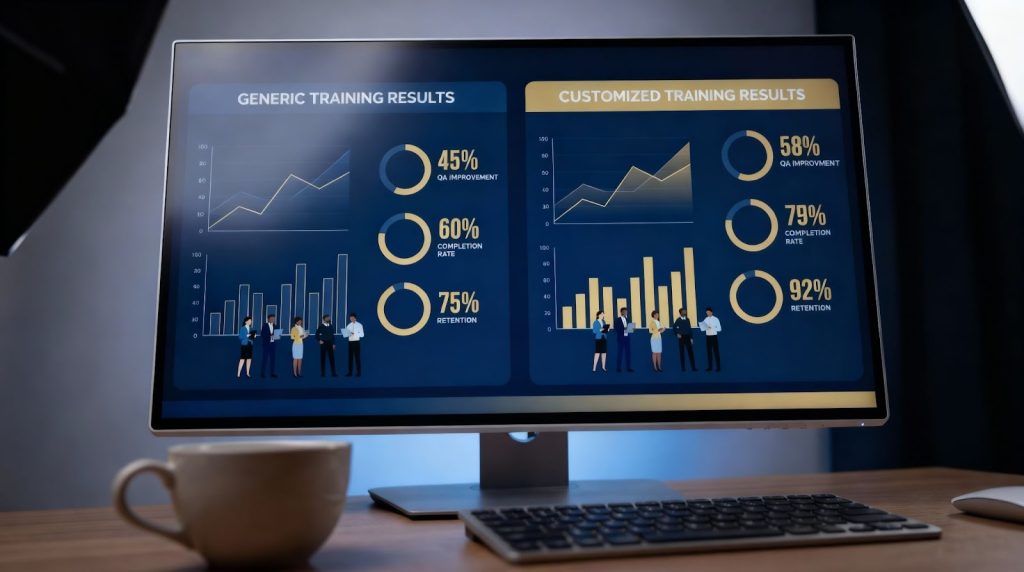
The outcome? VAs receiving ongoing coaching show 58% higher quality scores and 40% lower turnover than those getting orientation-only training.
Flaw #4 : Zero Performance Measurement
Generic programs don't track KPIs, progress, or outcomes. Success is defined as "training delivered" rather than "performance achieved."
Without measurement, there's no accountability. Agencies claim "comprehensive training" without proving results. There are no feedback loops for improvement. And you can't evaluate ROI—you invest thousands without knowing whether it delivered measurable outcomes.
Effective training requires clear metrics from day one. Leading indicators like training completion rates (we hit 79%) and time-to-first-independent-task (our average: 12 days). Lagging indicators like quality assurance scores (we see 58% improvement from baseline to month three), client satisfaction, and retention rates (we maintain 92% at 12 months).
This measurement discipline ensures you know—with precision—whether training works.
Flaw #5 : Ignoring Offshore-Specific Needs
Generic training treats domestic and offshore VAs identically, completely ignoring critical cultural, communication, and operational differences.
Three offshore needs get overlooked entirely:
Cultural integration: Communication directness norms vary dramatically. High-context cultures emphasize reading between the lines. Low-context cultures expect direct communication. When training doesn't address this, offshore VAs apply home-culture norms in contexts where different approaches are expected.
Timezone management: Offshore VAs need explicit training on asynchronous communication—comprehensive documentation, strategic use of video recordings, question consolidation to prevent multi-day back-and-forth.
Performance expectations: Concepts like "ownership mindset" and "proactive problem-solving" mean different things across cultures. Without explicit training bridging these gaps, offshore VAs struggle with unwritten rules domestic VAs absorb naturally.
When we place offshore talent, we add 4-6 hours of cultural training. The result? Our offshore VAs achieve 92% retention and performance matching domestic benchmarks because we address their actual needs.

What Effective VA Training Actually Looks Like
Effective virtual assistant training is a personalized approach that identifies individual skill gaps through structured assessment, then builds customized onboarding addressing those specific needs.
The difference isn't dramatic complexity—it's strategic focus. Both generic and effective training require roughly 40-60 hours over 30 days. Generic training spreads those hours across every possible topic at surface level. Effective training concentrates on areas where each individual needs development while moving quickly through existing strengths.
Start With Structured Assessment
Effective training begins before training starts. A three-part assessment identifies development areas so curriculum can target actual gaps.
Cognitive ability testing (15-20 minutes online) reveals learning speed, problem-solving patterns, and what complexity level someone can handle. This determines training pace—some people need less repetition and can handle strategic complexity earlier; others benefit from more structured guidance.
Job simulation interviews show how candidates actually perform tasks. Instead of asking "Tell me about your prioritization skills," present a realistic scenario: "Here's a calendar with conflicting meetings, urgent requests, and a project deadline. Walk me through the next two hours." Their approach reveals prioritization frameworks, communication patterns, and problem-solving methods.
When we hired Julia for content development, we gave her a 10-minute simulation: create a brief e-learning module. Her submission showed exceptional instructional design but revealed a gap in project timeline estimation. Her training concentrated on project management while leveraging her natural content strengths. Result: 79% training completion and consistently high-quality output.
Emotional intelligence evaluation through behavioral interviews assesses communication, collaboration, and resilience. EQ predicts long-term success and cultural fit more reliably than technical skills alone.
Build Personalized 30-Day Plans
Once assessment identifies needs, build customized onboarding balancing three elements: universal foundations everyone needs, personalized development targeting specific gaps, and role-specific training.
Days 1-10 establish foundations—technology stack, workflow processes, communication protocols, and organizational culture. This is fairly consistent across VAs, though pacing varies based on cognitive assessment.
Days 11-20 focus on targeted skill development customized to identified gaps. A VA with strong strategic thinking but weak prioritization spends this period on priority frameworks and time management. One with opposite needs focuses on business context and proactive problem identification.
When we onboarded Paola, assessment revealed exceptional strategic thinking but identified prioritization as a development need. Her days 11-20 concentrated on the Eisenhower Matrix, weekly planning protocols, and professional boundary-setting. This targeted approach transformed a potential weakness into competence within 30 days.
Days 21-30 integrate strategic business context. VAs learn why their role matters, how tasks connect to objectives, and decision-making frameworks for handling situations without clear precedent.
Add Business Context, Not Just Tools
Generic training teaches mechanics—how to create Google Calendar events. Effective training adds strategic layers—why certain meetings deserve executive time and others don't, how to recognize scheduling patterns indicating misaligned priorities, when to proactively suggest declining meetings that don't serve strategic goals.
This business context transforms calendar management from administrative task to strategic leverage.
Industry customization adds another layer. Beth's placement with a dental practice included patient experience psychology, appointment optimization, insurance verification specific to dentistry, and cancellation management. This enabled her to increase appointment adherence 23% and improve patient satisfaction 31% within six months.
Implement Ongoing Coaching
The critical differentiator between effective and generic training is what happens after day 30. Generic programs disappear. Effective programs recognize real skill development occurs through ongoing coaching as VAs encounter authentic complexity.
Our biweekly 1:1 model provides 30-45 minute sessions every two weeks for six months. Each session follows a consistent structure: performance review using data, challenge discussion where VAs raise blockers, targeted skill development, and goal setting for the next period.
This creates a safe space to ask questions without fearing client judgment. It addresses emerging challenges in real-time rather than waiting until problems compound. Most importantly, it enables continuous development targeting areas revealed through actual performance.
VAs receiving ongoing coaching demonstrate 58% higher quality scores, steeper productivity improvement curves, and 40% higher retention because they get the support needed to grow into strategic roles.
The Science Behind It: Schmidt-Hunter Framework
While most agencies rely on intuition, research-backed approaches use 100 years of industrial-organizational psychology to predict performance with measurable accuracy.
The Schmidt-Hunter meta-analysis reveals which methodologies actually work. Cognitive ability tests show 26% predictive validity for job performance. Structured interviews combined with work samples achieve 51% predictive validity—the highest of any hiring methodology.
This research matters because it separates evidence-based training from marketing claims. When agencies cite predictive validity showing their methods achieve 51% combined validity, you can verify whether their approach aligns with proven research.
Cognitive assessments reveal how to customize training pace and complexity. Someone scoring in the 80th percentile needs less repetition and can handle strategic complexity sooner. Someone in the 50th percentile—still entirely capable of excellence—needs more structured guidance and benefits from concrete examples before abstract frameworks.
Job simulations reveal gaps in real-time problem-solving, prioritization under pressure, and attention to detail. This performance data drives training customization. A candidate who struggled with prioritization but excelled at communication gets training concentrated on decision frameworks. One with opposite performance receives coaching on stakeholder updates and communication clarity.
Emotional intelligence predicts long-term success, cultural fit, and client relationship quality. High-EQ VAs proactively communicate when blocked, navigate ambiguous expectations by asking questions, maintain resilience with constructive feedback, and build trust through consistent reliability.
The data confirms EQ's importance: VAs with high EQ scores who receive targeted technical training show 40% lower turnover than technically strong VAs with lower EQ. Clients forgive technical mistakes from VAs who communicate proactively and take ownership, but lose patience with technically competent VAs who lack self-awareness.
Why Offshore Training Needs Different Approaches
Generic training's failure rate accelerates dramatically with offshore placements because cultural and communication differences compound every flaw.
This doesn't mean offshore talent is less capable—our offshore VAs achieve identical performance when training addresses their specific needs. The key word: specific.
Cultural Integration Is Critical
The most overlooked need is cultural integration—teaching VAs how to navigate cross-cultural workplace norms.
Communication directness varies dramatically. High-context cultures communicate indirectly, preserving harmony. Low-context cultures expect direct communication and explicit disagreement when appropriate. When training doesn't address this, offshore VAs apply home-culture norms where different approaches are expected.
A Filipino VA trained to show deference might not proactively flag unrealistic deadlines, hoping the client notices implied concern. The client, expecting direct communication, interprets silence as agreement and feels blindsided when the deadline is missed.
Effective training makes this explicit: "In U.S. business culture, direct communication is valued over preserving harmony. Your client expects you to flag problems proactively, disagree respectfully when concerned, and raise blockers before they impact deliverables."
Decision-making autonomy creates similar gaps. Some cultures emphasize asking permission; others expect autonomous decisions within role scope. Training bridges this with explicit frameworks: "For routine tasks you've performed successfully three times, proceed autonomously. For budget decisions over $X or client-facing communication, ask first."
When we placed Paola with a property management client, her cultural training specifically addressed communication directness. Within three weeks, she proactively flagged a vendor problem her predecessor avoided mentioning for months. The client told us: "Paola's willingness to surface problems early is exactly what we needed. She protects us from operational risk."
Asynchronous Communication Protocols
Timezone differences require different communication protocols. Offshore VAs need explicit training on over-communicating through comprehensive written updates, documenting decisions and reasoning, using video recordings for complex topics, and front-loading questions in single messages rather than serial back-and-forth.
We train end-of-day updates using this format: "Completed: [list with details]. In progress: [status, blockers]. Questions for tomorrow: [consolidated list]." This single update provides complete context and prevents delays.
How to Evaluate Your Options
Whether building internal training or evaluating agencies, here are the critical questions to ask:
1. "What assessment process do you use before designing training?"
Look for specific methodologies—cognitive testing, job simulations, emotional intelligence evaluation. Red flag: vague claims about "rigorous vetting."
2. "How is training customized to individual VAs?"
Look for concrete examples of adaptation based on assessment. Red flag: "We tailor to client needs" (client-level, not individual-level customization).
3. "What happens after the first 30 days?"
Look for ongoing coaching with specific cadence and structure. Red flag: "We're available if issues arise" (reactive, not proactive).
4. "What performance data can you share?"
Demand quantified outcomes—retention rates, quality improvements, productivity metrics. Red flag: only sharing testimonials without data.
5. "How do you handle offshore cultural integration?" (if applicable)
Look for specific cultural training components. Red flag: "Cultural differences aren't an issue with our talent."
Red Flags to Avoid
Methodology vagueness: If agencies can't explain training with specificity, they likely don't have methodology beyond generic checklists.
No ongoing coaching: If training description ends at "30-day onboarding," they're selling one-time training when research shows ongoing coaching drives improvement.
Speed-focused marketing: Claims like "Place VAs in 72 hours!" reveal prioritization of speed over quality. Effective assessment and training require time.
Lack of performance data: Agencies confident in training share quantified outcomes. Those lacking data either don't measure or don't like what it reveals.
Trust your instincts. If an agency's approach sounds identical to commodity services, it probably is.
Frequently Asked Questions
Why do virtual assistants fail after training?
VAs fail because generic training ignores individual skill gaps, skips cognitive and emotional intelligence assessment, provides task lists without strategic context, offers zero coaching after orientation, and lacks measurable KPIs to catch problems early. Research shows VAs receiving customized training with ongoing coaching achieve 58% higher quality scores and 40% lower turnover.
How long does it take to properly train a virtual assistant?
Initial intensive onboarding requires 20-30 days covering systems, tools, and role-specific skills customized to individual needs. But real development requires ongoing coaching for six months—biweekly sessions addressing emerging challenges. Time-to-productivity varies: administrative VAs typically achieve independence in 14-21 days; specialized roles need 30-45 days.
What's the difference between generic and customized training?
Generic training delivers identical content to everyone using standardized checklists, ending after orientation week. Customized training begins with assessment identifying specific development needs, builds personalized curriculum targeting those gaps, and includes ongoing coaching for continuous improvement. Outcomes: 58% higher quality scores, 79% training completion vs. 45-60% for generic, and 40% lower turnover.
Can offshore virtual assistants be trained as effectively as domestic VAs?
Absolutely, when training addresses their specific needs. Offshore VAs need everything domestic VAs receive plus cultural integration training, asynchronous communication protocols, and timezone management. Our offshore VAs achieve 92% retention and identical performance to domestic placements because we add 4-6 hours of cultural training rather than treating everyone the same.
The Bottom Line
Generic virtual assistant training programs fail because they prioritize scalability over effectiveness. The result: 67% failure rates, $12,000 rehiring costs, and executives trapped in operational tasks they hired someone to handle.
The alternative isn't more training—it's better training. Research-backed approaches begin with cognitive and emotional intelligence assessment, enabling customized onboarding that targets specific gaps. Role-specific training with business context transforms VAs from task executors into strategic partners. Ongoing coaching ensures continuous improvement as VAs encounter real-world complexity.
This delivers measurable outcomes generic approaches cannot match: 58% quality improvements, 79% training completion, 40% lower turnover, and 20-30% executive time reclaimed.
Whether building internal infrastructure or evaluating agencies, reject commodity "all our VAs are trained" claims. Demand methodology specificity. Verify assessment processes. Confirm ongoing coaching exists. Require quantified performance data.
Virtual assistant training isn't a commodity where cheaper and faster wins. It's the difference between a $12,000 rehiring cycle in 90 days and a multi-year strategic partnership that compounds ROI over time.
At Pathfinder Talent Solutions, we've placed VAs across seven industries with 92% retention because we built our training on Schmidt-Hunter research rather than generic checklists. Our structured assessment, customized onboarding, and ongoing coaching consistently produce outcomes commodity training cannot match.
If you're ready to experience the difference, let's talk. Schedule a consultation where we'll discuss your specific needs, explain our methodology, and determine if we're the right fit—no pressure, just honest conversation.